

“Dark Energy” is the Emerging Paradigm for Always-on Behind-the-Meter Electric Power
AI data centers need dependable electricity, and developers are increasingly considering power generation located at or near their facilities. Some investment commentary calls this “Dark Energy”: a promotional term for on-site natural-gas generation, particularly turbine-based systems. Here, the phrase refers to distributed generation, rather than the dark energy studied by cosmologists.
For engineers designing these installations, the opportunity extends beyond the turbine itself. Fuel delivery, heat recovery, filtration, instrumentation, and cooling all require specialized components. Photo chemical machining (PCM) offers a practical manufacturing option for selected thin-gauge metal parts throughout this supporting infrastructure.
Established Technology, New Applications
Gas turbines already serve industrial and utility markets. Their expanding role in data center infrastructure creates additional design requirements involving modular packaging, operating flexibility, and integration with cooling and electrical systems.
PCM selectively dissolves exposed metal through a patterned photoresist, producing intricate sheet-metal geometries without cutting forces or a laser-generated heat-affected zone. For suitable components, especially those below 0.040 inch thick, it can simplify complex patterns and enable economical design revisions.
The following applications represent potential engineering opportunities; suitability depends on each assembly’s operating conditions and qualification requirements.
Recuperator Foils and Heat Exchanger Layers
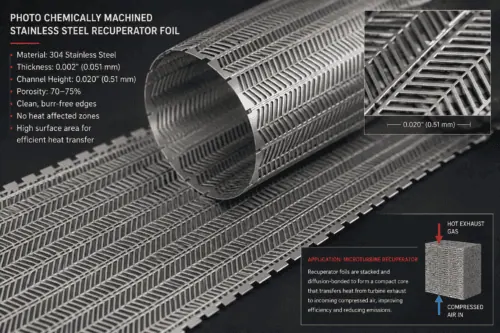
In recuperated microturbines, a heat exchanger transfers energy from turbine exhaust to compressed inlet air, reducing the fuel needed to reach the required combustion temperature. This architecture creates opportunities for thin metal components with repeated flow features.
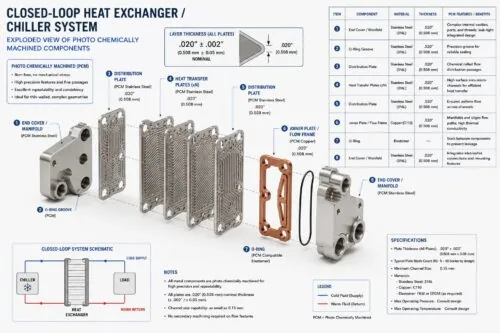
Potential PCM parts include patterned foils, separator layers, flow distribution screens, and alignment features for compact heat exchanger assemblies. Etching can produce numerous openings simultaneously and incorporate different patterns within the same sheet.
Engineers must distinguish these systems from larger turbines that use other cycle arrangements. Recuperator applications depend on the equipment architecture. Alloy selection, oxidation resistance, pressure drop, joining methods, and thermal fatigue remain essential design considerations.
Fuel and Fluid Management Components
Turbine packages depend on controlled flows of fuel, lubricating oil, and other service fluids. Candidate PCM components include protective screens, perforated distributors, thin spacers, and restrictor plates where the required flow characteristics match etched geometry.
Complex aperture patterns can be distributed across a small area without punching each opening individually. This approach may help engineers balance open area, particle exclusion, and packaging constraints.
However, etched openings have characteristic taper and undercut. Precision metering applications require flow testing and may need additional processing. A dimensionally acceptable aperture does not automatically provide the specified flow coefficient.
Cooling Plates and Thermal Management Layers
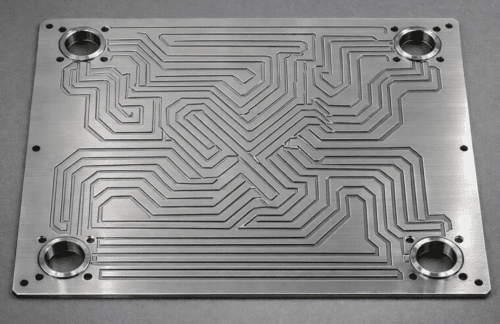
On-site power equipment and its associated electronics generate heat that must be removed reliably. Potential PCM applications include patterned layers for laminated cold plates, coolant distribution plates, and thin metal interfaces within compact heat exchangers.
Through-etched passages can become enclosed channels when layers are joined. Partial etching can also form shallow features where depth tolerances meet the design requirements.
These approaches may support cooling for power conversion electronics, controls, or nearby computing equipment. Copper offers thermal conductivity, while stainless steel may suit particular fluid and corrosion conditions. Final performance depends on channel geometry, coolant compatibility, bonding quality, and leak integrity.
Filtration, Shielding, and Instrumentation
PCM can also produce intricate screens for fluid circuits, protective grids for sensors, and shielding components for control electronics. Thin shims and spacers can help establish clearances or locate parts within instrumentation assemblies.
For filtration designs, engineers can specify aperture layout and open area to suit the application. Material thickness, minimum ligament width, pressure differential, and cleaning procedures must be considered together.
For electronics, etched blanks can incorporate ventilation patterns, attachment features, and bend lines before secondary forming. Shielding effectiveness still depends on the completed enclosure, seams, grounding, and operating frequencies.
Design for the Entire Assembly
PCM provides its greatest value when considered early in development. Designers should review material, thickness, minimum openings, dimensional tolerances, edge profile, and any forming or joining operations before releasing drawings. Conard’s published guidelines connect achievable features and tolerances directly to metal thickness.
Thin etched layers are not automatically pressure-rated components. Brazed, welded, or diffusion-bonded assemblies require appropriate inspection and validation. Hot-section turbine blades, thick structural housings, and heavily loaded rotating parts generally call for other manufacturing approaches.
Bring PCM Into the Design Discussion
For Conard Corporation, the opportunity lies in helping equipment designers identify thin-gauge components that benefit from complex geometry, burr-free fabrication, and flexible tooling.
As on-site generation expands, small components can influence flow distribution, thermal performance, serviceability, and assembly cost. Reviewing these parts early can reveal opportunities to simplify fabrication and accelerate development.
Designing a turbine support system, compact heat exchanger, filtration assembly, or cooling device? Contact Conard to discuss whether photo chemical machining fits your material, geometry, and production requirements.
For More Information