

Photo Chemical Machining Applications for Geothermal Energy Systems
As geothermal power generation expands to provide reliable, carbon-free baseload electricity, engineers continue to seek manufacturing technologies capable of producing increasingly sophisticated fluid management, heat transfer, and filtration components. Geothermal systems present one of the most demanding operating environments in the energy industry, requiring materials and components that withstand elevated temperatures, corrosive fluids, dissolved minerals, and continuous operation for decades.
Photo Chemical Machining (PCM), also known as photochemical etching, offers unique advantages for manufacturing the precision thin-gauge metal components used throughout modern geothermal power plants. Unlike stamping, laser cutting, or wire EDM, PCM produces burr-free, stress-free, highly accurate parts without inducing heat-affected zones or mechanical distortion. These characteristics make the process particularly valuable when manufacturing intricate components for heat exchangers, fluid distribution systems, sensors, filtration assemblies, and thermal management equipment.
Heat Exchanger Components
Heat exchangers represent one of the most critical assemblies in geothermal power systems. Binary-cycle geothermal plants, Organic Rankine Cycle (ORC) systems, and supercritical CO₂ power cycles rely heavily upon compact, high-efficiency heat exchangers to transfer thermal energy from geothermal fluids into secondary working fluids.
Photo chemically machined components commonly include:
- Microchannel flow plates
- Turbulence enhancement foils
- Spacer layers
- Distribution manifolds
- Thin-gauge separator plates
- Precision diffuser plates
PCM allows engineers to create thousands of identical flow passages only a few thousandths of an inch wide while maintaining excellent dimensional consistency over large surface areas. Complex channel geometries that maximize heat transfer can be manufactured without tooling stresses or expensive machining operations.
Fluid Distribution Plates
Uniform flow distribution is essential for maximizing geothermal heat recovery. Poor fluid distribution creates localized hot spots, uneven heat transfer, and reduced system efficiency.
Photo chemically machined flow distribution plates provide:
- Precisely balanced flow paths
- Equal pressure distribution
- Uniform velocity profiles
- Optimized mixing characteristics
- Low pressure losses
Because PCM can simultaneously produce hundreds or thousands of identical openings, it enables engineers to design sophisticated manifolds that would be prohibitively expensive using conventional machining.
Metal Filtration Components
Geothermal fluids frequently contain:
- Silica
- Calcium carbonate
- Iron oxides
- Sulfides
- Sand
- Scale particles
These contaminants can rapidly damage pumps, valves, turbines, and heat exchangers if not effectively removed.
Photo chemical machining is ideally suited for manufacturing precision metal filtration media including:
- Fine mesh screens
- Multi-layer laminated filters
- Support grids
- Flow straighteners
- Cylindrical filter elements
- Custom particle separators
Because PCM creates burr-free openings with smooth edges, flow resistance is minimized while maintaining highly repeatable filtration performance.
Downhole Instrumentation Components
Modern geothermal wells rely upon sophisticated instrumentation capable of operating in harsh environments exceeding 300°C.
Photo chemically machined components support:
- Pressure sensor diaphragms
- Temperature sensor elements
- Protective screens
- Calibration shims
- Precision spacers
- Electrical shielding components
The process can manufacture extremely thin stainless steel, Inconel, Hastelloy, nickel, titanium, and specialty alloy components without introducing residual stresses that could affect sensor accuracy.
Valve and Flow Control Components
Accurate regulation of geothermal fluids requires precision flow control devices.
PCM is commonly used to manufacture:
- Orifice plates
- Metering disks
- Flow restrictors
- Valve shims
- Diffuser plates
- Pressure balancing components
Because chemical machining creates smooth, burr-free openings, flow characteristics remain highly predictable while minimizing turbulence and erosion.
Turbine Components
Steam turbines and binary-cycle expanders depend upon carefully engineered fluid management components.
Photo chemically machined parts include:
- Steam separator screens
- Oil filtration media
- Cooling flow plates
- Bearing lubrication components
- Seal retainers
- Precision shims
The absence of heat distortion helps maintain the flatness required for high-performance rotating equipment.
Organic Rankine Cycle Systems
Many lower-temperature geothermal resources utilize Organic Rankine Cycle (ORC) technology to generate electricity efficiently.
PCM contributes to ORC equipment by producing:
- Recuperator foils
- Regenerator plates
- Condenser flow plates
- Evaporator channel layers
- Liquid distribution plates
- Refrigerant control components
These thin-gauge precision components improve thermal efficiency while reducing system size and weight.
Corrosion-Resistant Materials
Geothermal environments often require high-performance alloys resistant to chloride attack, sulfides, and aggressive chemical species.
Photo chemical machining is compatible with numerous corrosion-resistant metals including:
- Stainless steels
- Inconel
- Hastelloy
- Nickel alloys
- Copper alloys
- Titanium
- Alloy 20
Since PCM removes material chemically rather than mechanically, difficult-to-machine alloys can often be processed more economically than with conventional machining techniques.
Gaskets, Seals, and Shim Components
Geothermal equipment frequently requires precision sealing components capable of maintaining tight tolerances over wide temperature ranges.
PCM produces:
- Metal gaskets
- Compression shims
- Alignment shims
- Spring elements
- Retaining washers
- Seal support components
The process provides excellent edge quality without secondary deburring operations.
Thermal Management Systems
Auxiliary geothermal equipment includes numerous cooling systems for electronics, generators, power converters, and control equipment.
Photo chemically machined thermal management components include:
- Cold plate flow channels
- Microchannel cooling plates
- Heat spreaders
- Fin structures
- Flow distributors
- Liquid cooling manifolds
The intricate channel patterns achievable through PCM significantly improve cooling performance while minimizing pressure losses.
Environmental Monitoring Equipment
Geothermal facilities continuously monitor water chemistry and environmental emissions.
PCM supports environmental instrumentation by manufacturing:
- Sample flow restrictors
- Sensor housings
- Analytical instrument components
- Calibration plates
- Precision apertures
- Gas sampling components
The process provides exceptional repeatability for analytical applications requiring precise fluid control.
Advantages Over Conventional Manufacturing
Compared with stamping, laser cutting, or wire EDM, photo chemical machining offers several important benefits for geothermal applications:
- Burr-free edges that reduce turbulence and contamination
- No heat-affected zone or metallurgical changes
- No mechanical stresses that distort thin materials
- Economical production of highly complex geometries
- Simultaneous production of thousands of precision features
- Excellent repeatability from prototype through production
- Minimal tooling investment for design changes
- Capability to machine extremely thin metal gauges
- Excellent flatness for laminated assemblies
- High material utilization with minimal waste
These advantages become increasingly important as geothermal systems continue evolving toward more compact, higher-efficiency heat exchangers and advanced thermal management architectures.
Supporting the Future of Geothermal Energy
As enhanced geothermal systems (EGS), closed-loop geothermal technologies, supercritical geothermal wells, and advanced binary-cycle power plants mature, the demand for precision metal components will continue to grow. Higher operating temperatures, more aggressive fluids, and increasingly compact equipment require manufacturing processes capable of producing intricate, high-performance metal parts with exceptional consistency.
Photo Chemical Machining provides geothermal equipment designers with a manufacturing solution that combines precision, material versatility, and production efficiency. From microchannel heat exchangers and filtration systems to flow control devices, thermal management components, and advanced sensor assemblies, PCM enables innovative designs that improve efficiency, reliability, and service life. As geothermal energy becomes an increasingly important component of the global renewable energy portfolio, photo chemically machined precision metal components will continue to play a vital role in advancing cleaner, more efficient, and more reliable power generation technologies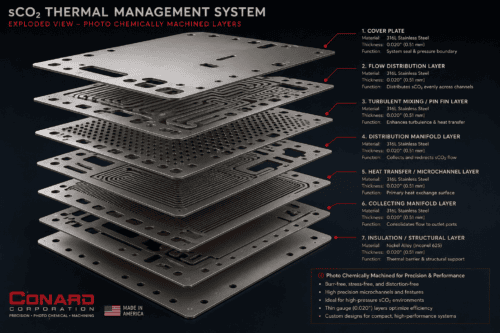
For More Information
Request for Quote
"*" indicates required fields
